
I grew up in a family of intellectuals. My parents were engineers; children of doctors, engineers and professors. And yet, I was always in sports. Partially unorganized: always playing outside with friends; biking, swimming, badminton, soccer, skateboarding, surfing, even rollerblading. But also organized: swimming, Judo, Karate, soccer, and obviously wrestling. The goal was not for me to become a professional athlete or compete in college ( even though I did) or even to become a coach (which I did), the goal was to be strong and healthy. However, in Soviet Union where I grew up, there was a divide between athletes and intellectuals, but only in that athletes went to specialized schools, but everyone did sports. This changed when I came to America.
In the US, I learned the word “Nerd” and “Jock”. Connotation was that Nerds were smart and therefore did not participate in sports. Jocks were not smart and therefore participated in sports. This seemed to be borne out of a unique American institution: school sports. Most countries in the world have PE, but they do not have school sports. They have clubs and sport centers, they don’t have publicly funded interscholastic competition. Because it is publicly funded, the spots are limited and as a result there are limited number of sports and spots on sports. This leads to cuts and as a result differences between nerds and jocks; because jocks who focus on sports make the teams and nerds do not.
As a foreigner, I did not understand this differentiation, and I refused to fall for it. I did notice that there were some sports that were more “nerd” and some sports were more “jock”. I ended being the in betweener – I did soccer and cross country which were nerd sports, but also wrestling and track which were the cool jock sports. My friends ended up being diverse, from both pools. However my understanding of sports and who belonged and who did not was still heavily influenced by this dichotomy, until I became a coach.
As a coach, that dichotomy in my mind began to break. Coming to a small program at a large school meant I had to recruit. Naturally people gravitated to wrestling who felt welcomed and could not make other teams. By and large our new comers were not athletes. They were “nerds”. Nerds who knew how to work hard and as a result they became athletes. It was a marvel to see someone who never did organized (or unorganized) sports, who could not do a push up or pull up, to transform in body and mind in a couple of seasons into strong and powerful wrestlers. Because the program reflected my engineering and intellectual bend, the kids who joined who were not good at school often improved in their academics as well. So I saw the athletes that joined start to take heavier class loads and succeed, earning our team one of the highest GPA’s on campus.
The program grew and suddenly I was looking at a roster of going from 12 to 20 to 35 to 70. At the same time the district was still paying $2900 for a head coach and $1300 for a JV coach. Wrestling requires a coach to be on the mat with a wrestler. I have to observe small movements and make changes. I can’t do that with 70 people. This required me to be there for two practices a day. I also had to create more tournaments to give wrestling time. I also have to be next to the wrestler and with 14 or more wrestlers at a time, you end up putting over 20,000 steps a day at a tournament. By my fifth year Lack of coaches due to huge time commitments and lack of pay puts a cap on programs. So we have to fundraise, for singlets, tournaments, coaches, facilities. As a result, schools in affluent areas can afford sports. Schools in poor areas cannot.
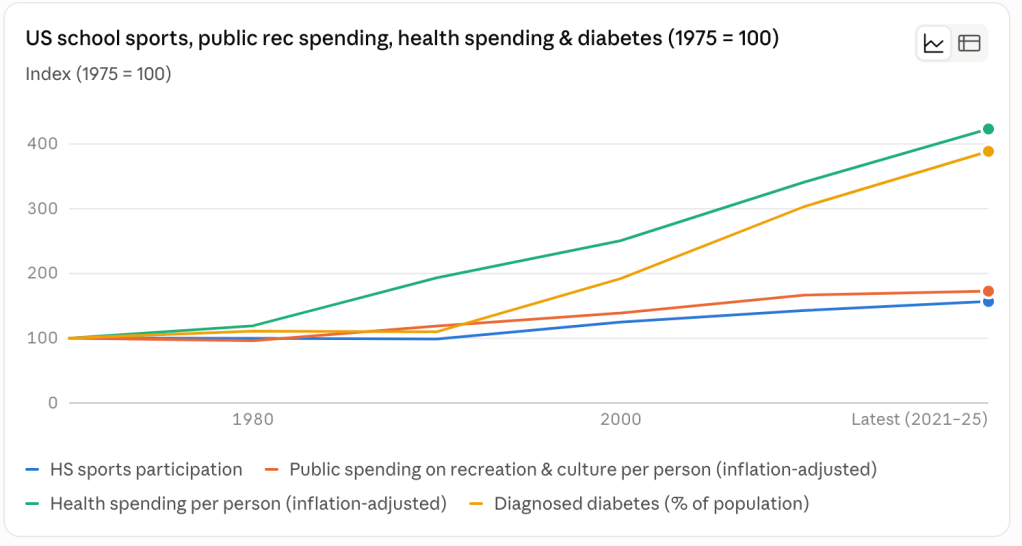
What is the impact? First is health. People who participate in sports are healthier and live longer. Schools that can fund sports programs still have relatively low sport participation. 50% is a high percentage. This means 50% of students are left without sports. This goes well in line with our country health outcomes. As funding for school athletics and college athletics was cut, the health costs and obesity rates climbed.
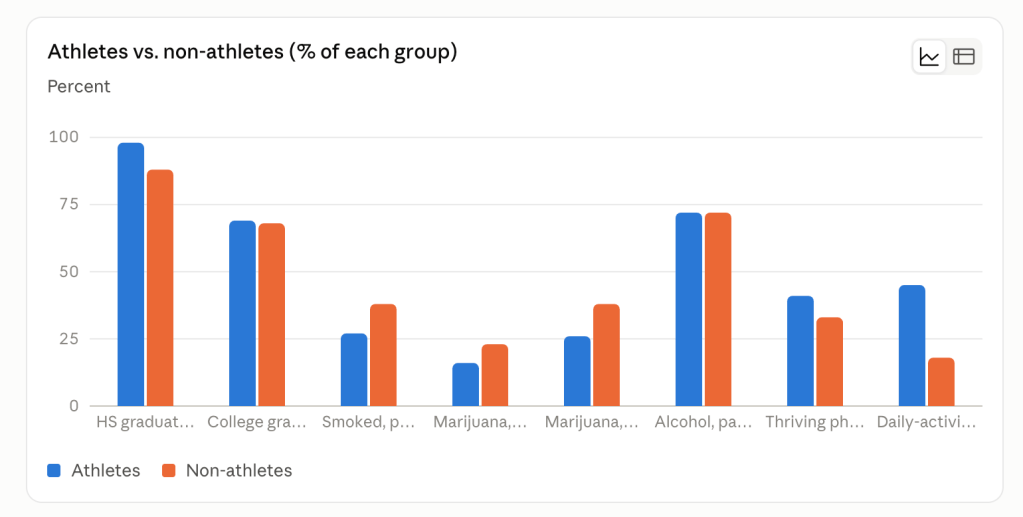
Second is academics. In spite of the “nerd”/”jock” mentality, the athletes routinely outperform their non athlete counterparts. The structure and discipline of sports and the academic requirements means they skip less school, they do better academically, they are less likely to do drugs or fall in with the “wrong crowd”. As a result they are more successul in life. They are more likely to go to college and after college they have better outcomes as well. While only 6% of college students participate in college athletics, 50% of female executives participated in College Athletics. People who do sports are not just healthier or better in academics, they are more successful because they are competitive, they are ambitious, they know how to set a goal and work towards it even when they don’t feel like it.
So what do I propose? Increase public funding for sports. Set an ambitious goal of sports for 70% of students in all schools. Provide funding for gear, coaches, transportation. This will cause our students to be healthier reducing health costs, smarter and more successful impacting their earnings and our economy.
I can see no better investment in our country, in our people than providing athletics to anyone and everyone. It’s a win win win.
References:
- Kansas athletes vs. non-athletes, Journal of Sport Administration & Supervision
- Education Week – athletes use fewer drugs, more alcohol
- NCAA Student-Athlete Substance Use, 2024
- Risk of Marijuana Use in College Athletes and Nonathletes
- NCAA – College athletes continue to graduate at record highs
- Gallup – Former Student-Athletes Are Winners in Well-Being
- Simon & Docherty 2014 – Health-related quality of life in former Division I athletes
- High school football and adult health – American Journal of Epidemiology


Leave a Reply